


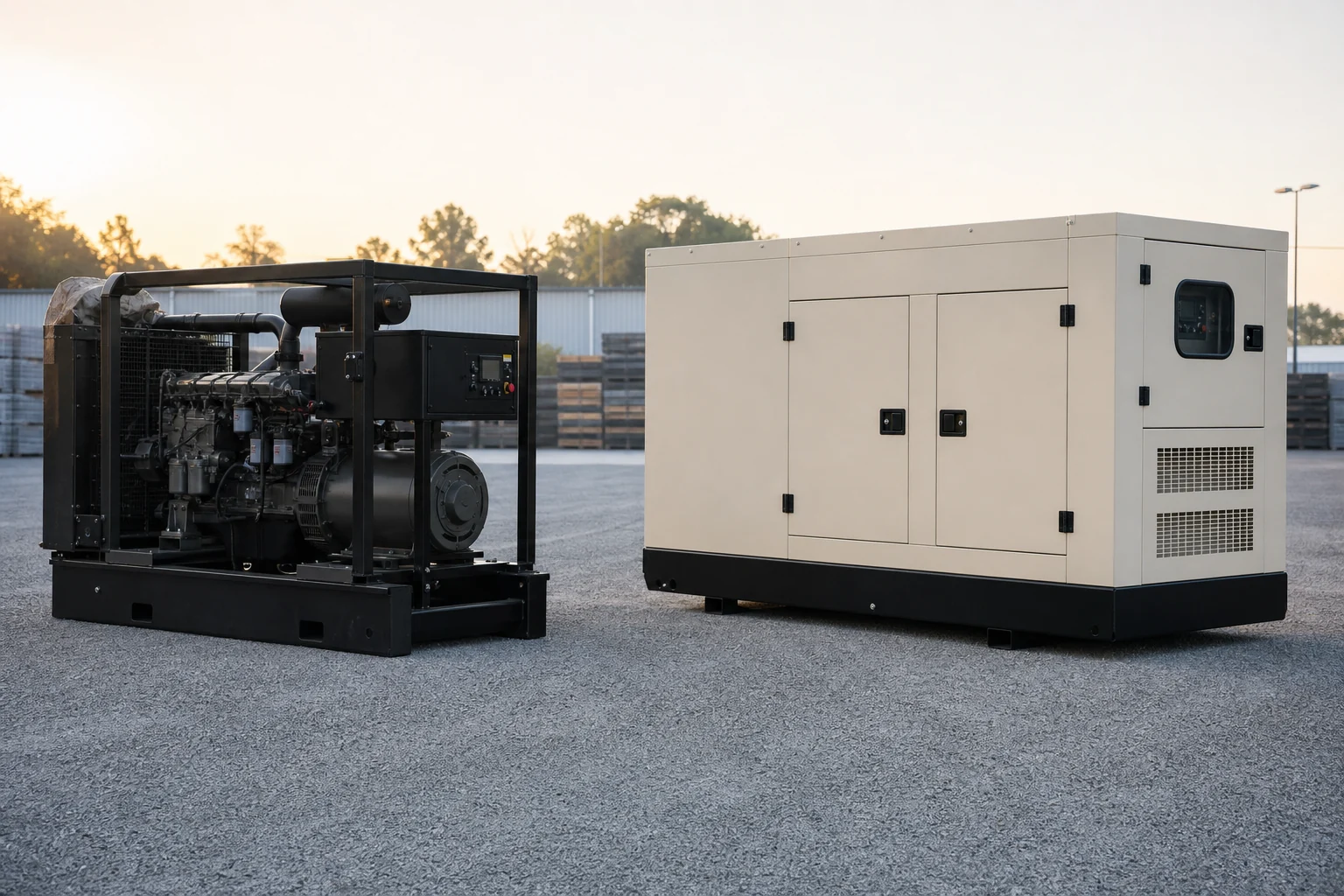



Open and silent generators can use the same basic engine and alternator, yet they solve different installation problems. The right choice depends on where the package will operate and which work belongs inside the supplier's scope.
What open and silent describe
An open generator set places the engine, alternator, radiator and controls on a base frame without a weather or acoustic enclosure. The components remain visible and easy to approach. This format is common inside purpose-designed generator rooms, workshops and industrial spaces where the building already provides weather protection, security and part of the acoustic treatment.
A silent generator places the set inside an enclosure designed to reduce radiated noise and protect the equipment from normal outdoor exposure. The enclosure usually includes doors, ventilation paths, acoustic lining and an exhaust silencing arrangement. Silent does not mean inaudible, and enclosure performance varies. The project still needs a stated sound criterion, measurement position, operating load and site boundary.
Installation responsibility changes the answer
Open sets work well when an engineering team controls the room layout. The building can provide large intake and discharge openings, dedicated exhaust routing, fire separation and custom acoustic treatment. This can produce an efficient installation, especially for large equipment or several generators. It also transfers more coordination to the designer, contractor and commissioning team.
A silent package moves part of that work into the factory-supplied enclosure. That can reduce site fabrication and shorten installation, but only if the standard package suits the climate, sound target and access constraints. Foundations, cable routes, fuel connections, exhaust discharge, drainage and external clearances remain project work. Treat the enclosure as one coordinated subsystem, not as permission to place the set anywhere.
Noise needs a measurable requirement
Noise depends on engine combustion, exhaust, cooling airflow, mechanical vibration and sound escaping through openings. An enclosure addresses several paths, but its published result only makes sense with test conditions. Ask for the sound pressure level, distance, load, measurement method and whether the figure represents an average or a specific position. A single dB number without those details is difficult to use in a site assessment.
The receiving environment matters as much as the package. A generator near offices, housing, a hospital or a property boundary may need a project acoustic study. Walls can reflect sound, while louvres and discharge openings can direct it toward sensitive areas. If the target is strict, coordinate enclosure performance with barriers, exhaust treatment, vibration isolation and the operating schedule.
Cooling and ventilation remain critical
Both formats must provide combustion air, cooling airflow and a way to remove heat. An open set relies on the room and its ductwork. A silent set uses enclosure openings and internal airflow paths. Adding screens, louvers, bends, barriers or long ducts creates pressure loss. The final arrangement must stay within the generator manufacturer's allowable restriction and temperature limits.
Do not select an enclosure by outer dimensions alone. Check radiator airflow, hot-air recirculation risk, prevailing wind, intake contamination and service access around the openings. In hot climates, a package designed for moderate ambient temperature may require a larger cooling system. In cold climates, dampers or controlled recirculation may be needed, but these features must return to the correct position when the set runs.
Maintenance access affects lifetime cost
An open set usually gives technicians direct access to filters, belts, batteries and wiring. Major component removal can also be easier if the room has suitable doors and lifting provision. The tradeoff is that the room must remain clean, secure and safe. Poor housekeeping or uncontrolled storage around the set can block airflow and service routes.
Enclosure doors concentrate access into fixed locations. A compact package may fit the allocated footprint but leave too little space to open doors or withdraw parts. Review routine service tasks and major removal paths on the general arrangement drawing. Door seals, hinges, acoustic lining and weather joints also become maintenance items. These details are easy to miss when quotations only compare engine and alternator brands.
Compare the complete installed scope
Open equipment often has a lower package price, but the project may need a generator room, louvers, ductwork, exhaust treatment, acoustic lining, doors and construction labor. A silent set includes more factory work, yet transport size, lifting weight and site access can increase. Neither option is always cheaper. The meaningful comparison includes civil, mechanical, electrical and commissioning work.
Ask each supplier to identify the boundary of supply. Confirm the silencer, flexible connections, breaker, battery system, base fuel tank, control wiring, cable termination space and weather rating. Review which parts arrive assembled and which require site installation. This prevents a low package price from becoming an incomplete project budget.
| Question | Open generator | Silent generator |
|---|---|---|
| Weather protection | Provided by building or site structure | Partly provided by the enclosure |
| Acoustic control | Designed around the room and exhaust | Integrated to a stated package level |
| Service access | Usually broad, subject to room layout | Limited to designed doors and panels |
| Site coordination | More building and mechanical design | More factory integration, still site dependent |
A practical choice sequence
Choose the installation location first. Record the sound target, climate, available footprint, transport route, maintenance plan and construction responsibilities. If the project already has a properly designed plant room and needs flexible access, an open set may be the cleaner solution. If outdoor weather protection and moderate acoustic control should arrive as one package, a silent set may reduce site work.
For either choice, request a general arrangement drawing and review clearances before approval. Confirm that the quoted sound data and environmental rating apply to the offered configuration. Then check ventilation, exhaust, fuel, cables and lifting as a single layout. The enclosure decision is complete only when the generator can operate, be serviced and be replaced safely in its actual location.
- Fix the installation location and sound criterion.
- Check climate, airflow and contamination exposure.
- Review routine and major service clearances.
- Compare installed project cost and responsibility boundaries.
- Approve the package drawing before civil work is frozen.
Compare the full installation, not only the enclosure
An open set can look less expensive on the equipment schedule, but the site still needs weather protection, safe access, ventilation, exhaust routing and noise control. A purpose-built generator room may already provide those functions. If it does not, the civil and acoustic work belongs in the comparison. The same rule applies to a silent set: the enclosure does not remove the need to plan the foundation, cable route, fuel system, exhaust discharge or service clearance.
Ask suppliers to define exactly what their price includes. Confirm the base frame, fuel tank, batteries, charger, breaker, silencer, flexible connections, enclosure material, door hardware and lifting arrangement. Then compare transport dimensions, installed footprint, site labor and commissioning scope. This makes the open versus silent decision a project-cost comparison instead of a choice based only on the generator purchase price.