


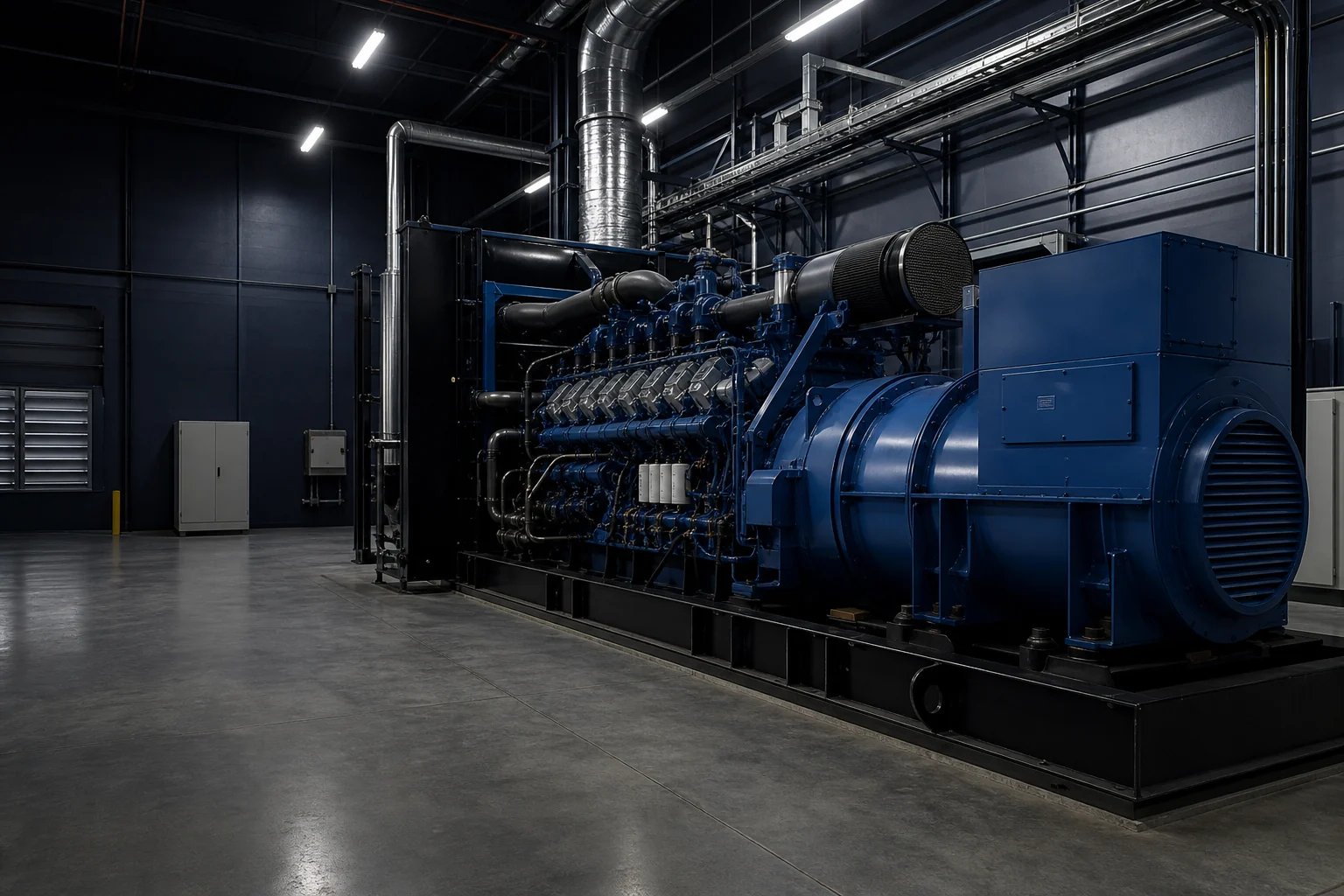



Generator selection starts before a model number appears. A useful specification describes the load, operating duty, electrical system, site and package boundaries clearly enough for an engineer to check the result.
Start with the operating problem
A generator is part of an electrical system, not a stand-alone appliance. The same connected load can lead to different selections depending on whether the set supports emergency lighting for a few hours, runs a remote production site every day, or carries motors that start together. Begin by writing down what must keep operating, what may be shed, how quickly power is needed and what happens if the generator stops. Those answers establish the duty before anyone compares catalog ratings.
Do not use the building service size, transformer size or a previous project as the only basis for selection. Those figures may include spare capacity, diversified loads or operating conditions that do not apply here. A supplier can work with incomplete information, but the quotation should identify every assumption. Hidden assumptions are the main reason two apparently similar offers can contain very different generator sizes, controls and accessories.
Build a load schedule that reflects operation
List each significant load with its running power, starting method, expected starting current, power factor and operating sequence. Mark loads that are continuous, intermittent or available for load shedding. Motors, compressors, pumps, lifts, transformers, welders and power electronic loads deserve separate attention because their starting or transient behavior can be more demanding than their steady running demand. If exact data is unavailable, record the equipment nameplate and control method instead of guessing.
The useful total is not always the arithmetic sum of every nameplate. Some loads never run together, while others must start during the worst operating condition. Create realistic scenarios such as normal operation, emergency operation, restart after an outage and future expansion. For each scenario, identify the largest single load step. This gives the sizing engineer a clearer basis for checking voltage dip, frequency response and recovery than a single total kW figure.
- Running kW or rated input for each load
- Power factor or kVA where known
- Starting method and expected starting current
- Operating sequence and simultaneous loads
- Loads that may be delayed or shed
- Planned expansion that is already funded or defined
Choose the rating from the duty
Prime, standby and continuous labels describe operating applications and limits. They are not interchangeable names for the same output. ISO 8528-1 provides a common framework, but manufacturers may publish additional rating names or conditions. State whether utility power is available, the expected annual operating hours, the likely average load, the maximum load and whether overload capability is required. Then ask the supplier to identify the rating definition used in the offer.
A larger nameplate does not automatically solve a rating mismatch. Oversizing can leave a diesel engine running at light load for long periods, while an undersized set may not accept a motor step or may exceed the intended duty. The selection should fit both the peak event and the typical operating profile. If the load changes widely, staged generators, load management or a different system arrangement may be more suitable than one oversized machine.
Confirm the electrical system
Specify voltage, frequency, phase, wiring arrangement, earthing method and the point where the generator connects to the system. State whether the set works alone, transfers through an ATS, parallels with another generator or operates with the utility. Control and protection requirements follow from that arrangement. A simple standby set and a synchronised multi-set plant may use similar engines but need very different switchgear, sensing and communication.
Power quality also matters. Sensitive electronic loads, UPS systems, variable speed drives and non-linear equipment can affect alternator selection and voltage regulation. Motor starting may require a transient study rather than a fixed sizing rule. Provide the load list and available equipment data so the supplier can check alternator capability, excitation, short-circuit performance and the expected voltage and frequency response.
| Item | What to provide | Why it matters |
|---|---|---|
| System | Voltage, frequency, phase and earthing | Defines the basic generator and switchgear arrangement |
| Transfer | Manual, ATS, closed transition or parallel | Changes controls, interlocking and protection |
| Loads | Motors, UPS, drives and sensitive equipment | Affects transient and alternator checks |
| Expansion | Defined future load and timing | Allows planned capacity without arbitrary oversizing |
Match the package to the site
Site conditions can reduce available engine power or change the cooling and enclosure design. Provide ambient temperature, altitude, dust, humidity, precipitation, corrosive atmosphere and any local emissions or noise requirements. Indoor installations also need room dimensions, access routes, ventilation constraints and exhaust routing. Outdoor sets need a realistic view of weather exposure, drainage, security and maintenance access.
Choose open, silent or containerized construction from the installation problem rather than appearance. An open set may suit a designed plant room with separate acoustic treatment. A silent enclosure can simplify an outdoor installation but still needs airflow, service clearance and an appropriate exhaust arrangement. Containerized packages may support larger systems or difficult environments, yet transport dimensions, lifting points and local access must be checked before the layout is frozen.
Plan fuel, service and logistics
The fuel system should support the required runtime and local operating practice. Confirm fuel quality, storage limits, day tank arrangement, transfer pumps, leak containment and refilling access. A long theoretical runtime is not useful if fuel cannot be delivered safely or if the stored fuel cannot be maintained. For remote sites, include the expected delivery interval and the consequences of a delayed delivery.
Service access belongs in the initial layout. Check the space needed to replace filters, remove batteries, service the radiator and lift major components. Ask which consumables and recommended spare parts should be available at commissioning. Logistics also affect the package: shipping method, destination restrictions, lifting capacity, route dimensions, foundation details and installation responsibility should appear in the project brief.
Compare quotations on the same basis
A useful quotation states the selected rating, engine and alternator, controller, enclosure, fuel arrangement, cooling method, switchgear boundary, included accessories and excluded work. It should also list the load and site assumptions used for selection. Compare those items line by line. A lower price may omit the ATS, breaker, battery charger, silencer grade, fuel system, commissioning or documentation that another supplier included.
Before placing an order, close the open technical items and issue a final agreed specification. Request drawings, data sheets and the proposed factory test scope for review. The goal is not to remove every project risk with paperwork. It is to make the equipment boundary and selection basis visible, so the supplier, installer and end user are discussing the same system.
- Selected model and rating definition
- Reference site conditions and derating basis
- Included controls, switchgear and accessories
- Factory test scope and documentation
- Installation, commissioning and training boundaries
- Named exclusions and information still required