

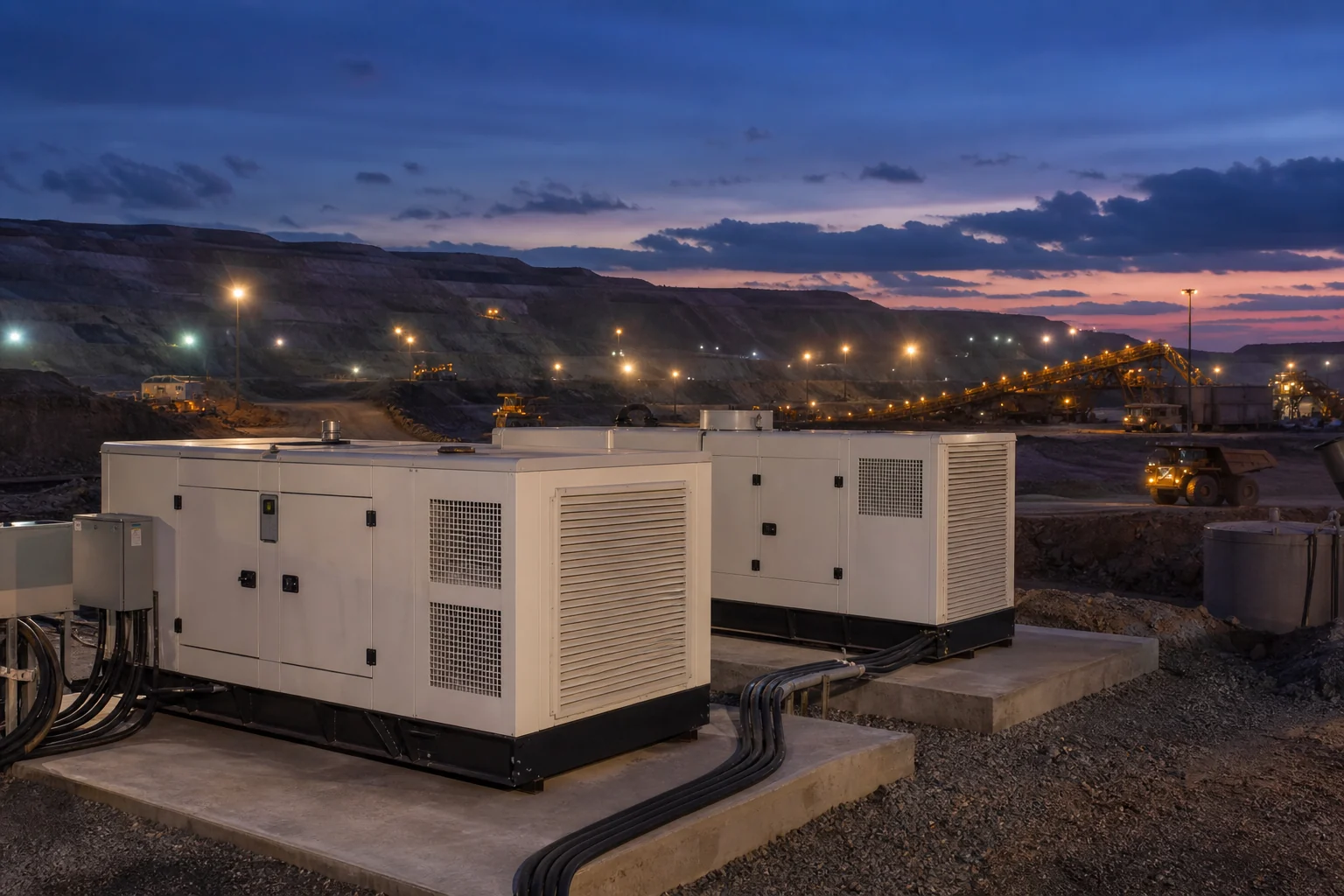



Mining power systems operate around production schedules, large motors, harsh environments and long supply routes. Selection should begin with the operating sequence and support plan, not with a generic harsh-duty label.
Define what the power system supports
Mining sites can include crushers, conveyors, pumps, ventilation, dewatering, workshops, camps, communications and processing equipment. These loads do not have the same consequence of failure. Identify which systems stop production, protect people or prevent environmental damage. Then define which loads must remain available during maintenance or a generator fault.
A load list should follow the process flow. Record which equipment starts first, which machines depend on upstream equipment and which loads cycle automatically. A simple connected-load total can hide the largest event, such as starting a crusher while pumps and conveyors are already running. The selection basis should describe that event and the acceptable voltage and frequency response.
Separate temporary, prime and standby duty
Construction power, exploration camps, temporary dewatering and permanent production can require different generator duties. A set that runs every day needs a rating and maintenance plan suitable for prime operation. A standby set for a grid-connected processing plant has a different operating profile. State expected hours, average loading, peak loading and seasonal changes for each operating mode.
Avoid describing a mining project as heavy duty without numbers. The supplier needs to know how long the set runs, how often large load steps occur and whether parallel operation is expected. If production demand changes across shifts, provide the typical and maximum profiles. Multiple smaller sets may follow the load more effectively and provide maintenance flexibility, but the control and switching arrangement must be planned.
Check motor and process loads
Crushers, mills, conveyors, compressors and pumps can impose high starting current and mechanical acceleration demand. Record motor ratings, starting methods, driven inertia and expected start sequence. Variable speed drives may reduce starting current, but their rectifier input and harmonic behavior still need review. The generator must support the complete process start, not only individual motor nameplates.
Load shedding can protect a site from a single severe step. Define which loads may be delayed, stopped or restarted automatically after a disturbance. Coordinate these priorities with the generator controller, plant control system and switchgear. A useful sequence reduces unnecessary generator capacity while keeping safety and production constraints visible.
- Largest motor and starting method
- Motors that start while the process is loaded
- Conveyors or pumps that must start in sequence
- Loads available for automatic shedding
- Restart sequence after a complete outage
- Sensitive controls and communication systems
Use actual environmental conditions
Altitude and high ambient temperature can reduce engine and cooling performance. Dust can block radiator cores, air filters and enclosure openings. Fine conductive material may also affect electrical equipment. Provide site elevation, seasonal temperatures, dust type, wind, precipitation and corrosion exposure. If the site data is uncertain, use a documented design envelope and confirm it before final manufacture.
Cooling systems need space and maintainable airflow paths. A larger radiator or remote cooling arrangement may be required, but each option changes pressure loss, fan power and service work. Place air intakes away from haul-road dust where possible. Review filtration and cleaning access with the maintenance team, since a technically suitable filter can still fail operationally if it is difficult to inspect or replace.
Plan fuel as part of production
Remote generation depends on the fuel supply chain. Estimate consumption across realistic loading, not only full-load catalog data. Define storage capacity, delivery interval, road access, fuel quality management, transfer pumps and containment. Include the effect of bad weather or disrupted deliveries. A long runtime claim has little value if the transfer system or refilling plan is weak.
Monitor fuel condition and protect storage from water and contamination. The project should also define who owns fuel sampling, filtration and tank maintenance. If alternative fuels are being considered, confirm engine approval, storage behavior and local availability for the exact offered model. Do not extend a fuel claim from one engine family to another without written manufacturer data.
Design redundancy and maintenance access
The required redundancy depends on the cost and consequence of lost power. A single generator may be acceptable for a temporary non-critical load. Continuous production, dewatering or safety systems may require multiple sets, separated essential buses or an alternative source. Define whether the system must carry full load during one unit's maintenance and how failed equipment will be isolated.
Maintenance planning should match site capability. Confirm service intervals, technician access, lifting equipment, spare parts and the route for replacing major components. Remote monitoring can help identify developing issues, but it does not replace local inspection and response. The control system should present useful alarms in a form the site team understands and can act on.
| Area | Information to provide | Design decision |
|---|---|---|
| Process | Critical loads and start sequence | Capacity, transient response and shedding |
| Environment | Altitude, temperature, dust and weather | Cooling, filtration and enclosure |
| Fuel | Delivery route, storage and runtime | Tank and transfer system |
| Support | Skills, spares and lifting access | Maintenance and redundancy plan |
Prepare the supplier review package
Issue a load schedule, single-line diagram, site data, operating philosophy and layout constraints. Mark which information is confirmed and which is preliminary. Ask the supplier to return the selected rating, derating basis, transient assumptions, cooling arrangement, fuel boundary, controls, switchgear and recommended spares. The offer should also identify exclusions and information needed before order.
Review the proposed package with electrical, mechanical, civil, operations and maintenance teams. Mining projects often fail at the interfaces: an enclosure that blocks filter removal, a fuel tank the delivery truck cannot reach, or a switchboard that does not support the restart sequence. A cross-discipline review catches these issues before the equipment arrives at a remote site.
Plan for maintenance where the generator will work
Remote mining sites can turn a routine service item into a long outage. Review the distance to trained technicians, road access, lifting equipment, fuel quality controls and the stock of filters, belts, hoses and starting batteries. Service intervals come from the selected manufacturer and operating conditions, so the project plan should use the approved schedule rather than a generic number. Dust, heat, altitude and long running hours may change that schedule.
The layout should allow technicians to reach filters, drain points, radiator surfaces, batteries and control equipment without removing unrelated components. Provide safe lighting, isolation points and enough room for the lifting method expected on site. If major components cannot be removed through the enclosure or building access, maintenance work may require avoidable dismantling later.
Agree how the site will report alarms, running hours and fuel condition. A remote monitoring link can help, but it needs communications coverage, access control and a clear response owner. Monitoring is useful only when someone is responsible for reviewing the alert and arranging the correct site action.