


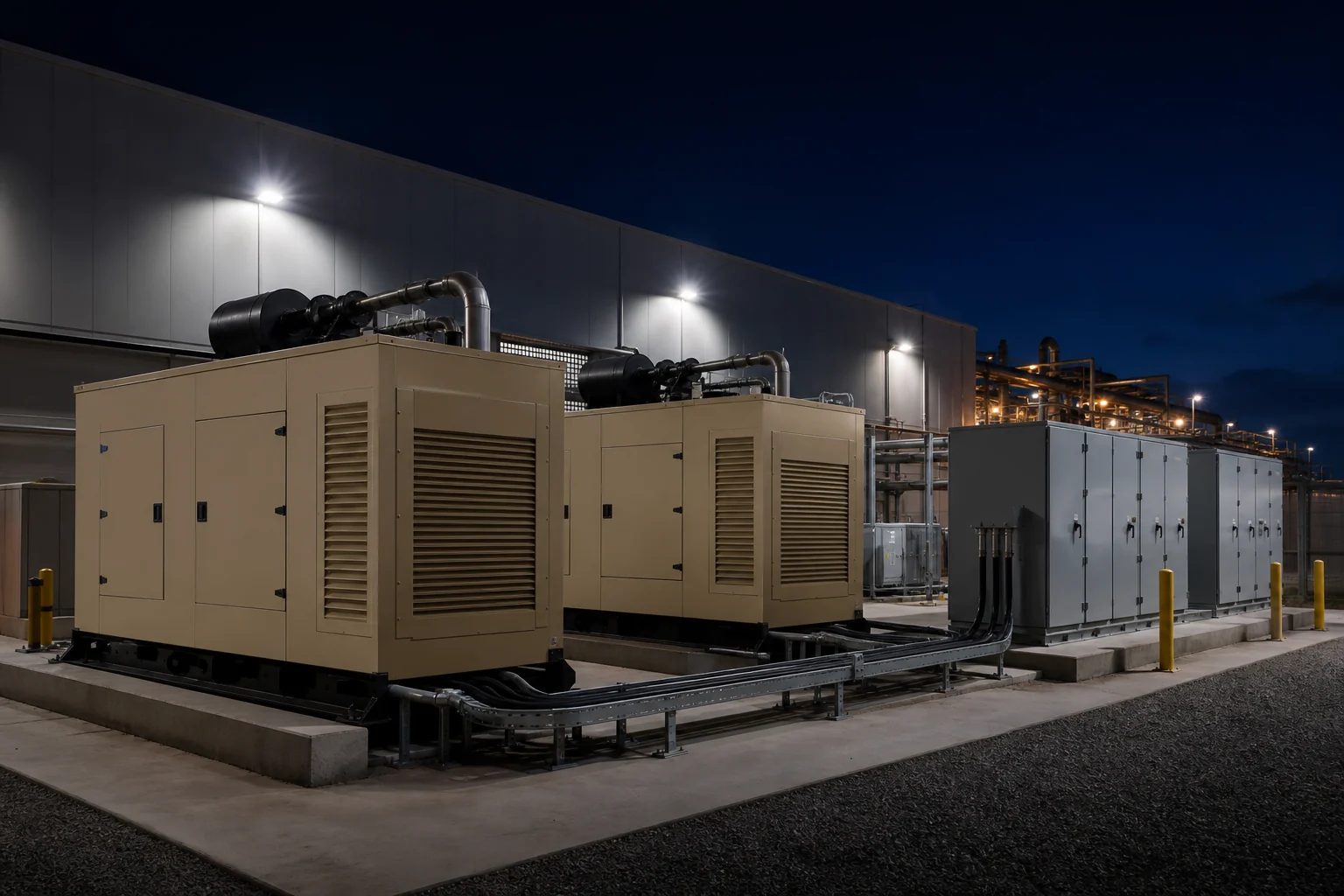


A generator's frequency must match the electrical system and connected equipment. Changing between 50Hz and 60Hz can affect speed, voltage, cooling, controls and available output.
Frequency is a system requirement
Alternating-current frequency describes the number of electrical cycles per second. Many power systems operate at either 50Hz or 60Hz, but the project requirement comes from the local electrical system and connected equipment. Confirm frequency alongside voltage, phase and earthing before requesting a generator. A country list can be a preliminary reference, not a substitute for the project specification.
Equipment designed for one frequency may not behave correctly on the other. Motors, clocks, transformers, UPS systems, drives, lighting ballasts and control power supplies can have frequency limits. Some devices accept both frequencies, while others require derating or a different connection. Review equipment nameplates and manufacturer data for the actual load, especially when machinery is imported.
Generator speed and pole count are linked
Synchronous frequency depends on alternator speed and pole count. A common four-pole alternator operates at 1500 rpm for 50Hz and 1800 rpm for 60Hz. Other pole counts use different speeds. The engine governor and alternator design work together to maintain the required frequency as load changes.
The speed difference affects more than the display value. Engine output, cooling fan performance, alternator characteristics, vibration and noise can change. Manufacturers publish separate 50Hz and 60Hz ratings because the complete set may not deliver the same kW or kVA in both configurations. Use the data sheet for the selected frequency and model.
Voltage is related but not identical
Markets that use 50Hz and 60Hz often use different nominal voltages, but frequency does not determine voltage by itself. Alternators may support several reconnectable voltages, and transformers can change voltage without changing frequency. The quotation must state both values and the winding connection, not rely on a regional shorthand.
Check line-to-line and line-to-neutral voltage, phase arrangement, system earthing and allowable tolerance. Confirm the control power, battery charger, jacket-water heater and other auxiliaries as well as the main output. A generator can have the correct main voltage while an accessory is supplied for the wrong site voltage or frequency.
| Item | What to confirm | Risk if missed |
|---|---|---|
| Generator | Rated frequency, speed and output | Wrong rating or unstable operation |
| Alternator | Winding, AVR and frequency settings | Incorrect voltage response or protection |
| Loads | Frequency and voltage tolerance | Overheating, speed error or malfunction |
| Auxiliaries | Heaters, chargers, pumps and fans | Package operates incompletely |
Motor loads require special attention
The speed of an induction motor is related to supply frequency and motor pole count. Running a motor at a different frequency changes its speed and can alter the driven process. Pumps and fans are especially sensitive because power demand can rise sharply with speed. Voltage-to-frequency ratio also affects magnetic flux and heating.
A variable speed drive may accept a range of input frequencies and provide the required motor output, but this must be confirmed for the exact drive and bypass arrangement. Contactors, timers, solenoids and cooling fans still need review. Do not assume that one drive makes the whole machine frequency independent.
AVR and protection settings must match
Automatic voltage regulators commonly include under-frequency protection or frequency selection settings. Manufacturer instructions may require links, jumpers or adjustments for 50Hz or 60Hz operation. These settings help the alternator respond correctly when speed falls, but they do not convert the engine, alternator and auxiliaries into a different rated package.
The governor, controller, protection relays, metering and synchronising equipment also use frequency thresholds. A conversion review must include start and stop logic, overspeed settings, under-frequency protection and any parallel control. If the set operates with an ATS or utility parallel system, the switchgear settings and utility requirements need confirmation too.
Can a generator be changed from 50Hz to 60Hz?
Some generator sets can be reconfigured, while others require component changes or are not approved for conversion. The review should cover engine speed capability, available power, alternator winding and rating, AVR settings, radiator and fan performance, exhaust, controller software, protection and every frequency-sensitive auxiliary.
A move from 50Hz to 60Hz usually increases speed for the same pole count. That does not mean output can be increased without limit. A move from 60Hz to 50Hz reduces speed and can reduce cooling airflow or engine output. Request a manufacturer-approved conversion procedure and revised data sheet. Recommission the set under load after any approved change.
Procure the correct package the first time
State installation country, required frequency, voltage, phase, load list and duty in the RFQ. Include imported machinery and any equipment with a restricted frequency range. Ask the supplier to confirm generator speed, 50Hz or 60Hz rating, output, winding connection, AVR configuration, auxiliaries and available test documentation.
During factory testing, verify voltage and frequency at no load and representative load, then check transient response if the project requires it. Confirm labels, drawings and manuals match the supplied configuration. A clear frequency specification prevents a costly site conversion and gives the installer a reliable basis for protection, cabling and commissioning.
- Required frequency and voltage
- Generator speed and rated output
- Alternator winding and AVR configuration
- Motor, UPS, drive and transformer compatibility
- Auxiliary equipment voltage and frequency
- Factory test and commissioning checks
Treat imported equipment as a separate compatibility check
Projects often combine locally purchased equipment with machines supplied from another market. The building voltage may be correct while a motor, heater, timing circuit or cooling fan still expects a different frequency. Create a list of imported loads and record the full nameplate data for each one. Where a nameplate shows a range, confirm that the complete machine and its controls share that range. A dual-frequency power supply inside the control cabinet does not prove that the motor or driven process can use both frequencies.
For motors, confirm rated voltage, frequency, speed, connection and service conditions. A frequency change alters motor speed unless a suitable drive controls the output. Pumps, fans and compressors can place a different mechanical load on the motor when speed changes. Ask the equipment manufacturer to approve the proposed supply and operating point rather than relying on a voltage conversion alone.
Transformers change voltage but do not change frequency. Electronic frequency converters may suit certain loads, but their capacity, harmonics, protection and bypass arrangement must be engineered for the project. It is usually clearer to procure the generator and critical loads for one agreed site frequency than to create several conversion points that technicians must understand and maintain.
Record the final decision on the single-line diagram, equipment schedule and generator data sheet. During factory or site testing, check the nameplate frequency, engine speed, controller settings, output voltage and the operation of frequency-sensitive auxiliaries. The documents and labels should match the tested configuration.